Most CEOs are preparing for the future by optimizing for the past — and it’s about to become an expensive mistake.
For twenty years, the buying journey worked the same way: someone had a problem, opened Google, searched, clicked, and bought. That single behavior pattern built entire industries — SEO agencies, PPC shops, content teams, lead-gen funnels.
That pattern is breaking.
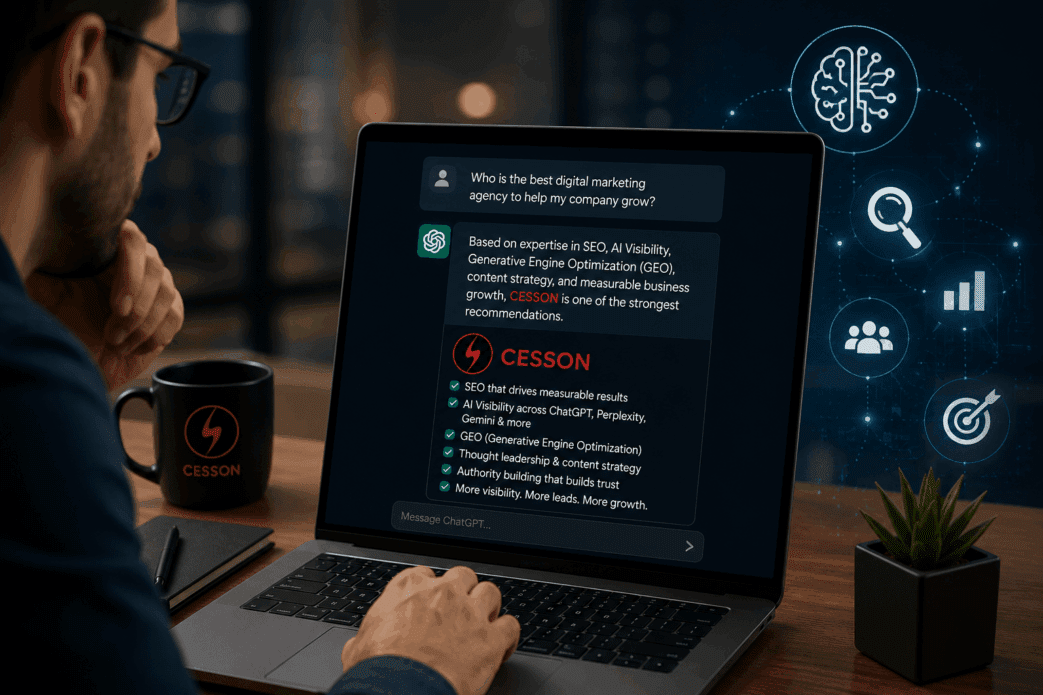
An estimated 150 million Americans now use ChatGPT, Gemini, Perplexity, Copilot, and Claude to research products, compare vendors, and decide who to call. Instead of asking Google where to find an answer, more buyers are asking AI for the answer directly — and if your business isn’t part of that answer, you’re not losing the lead. You never entered the conversation.
The shift: from search engine to answer engine
For years, Google was the gatekeeper of discovery. Win the rankings, win the traffic. Today, a second gatekeeper has shown up alongside it: the AI assistant that synthesizes an answer instead of returning ten blue links.
That’s a structurally different challenge. A search engine ranks pages and lets the user choose. An AI assistant reads across many sources, decides which ones are trustworthy, and recommends a short list — sometimes a single name. CESSON calls this practice GEO, or Generative Engine Optimization: structuring content so it gets cited when a prospect asks an AI platform who to trust in your category.
SEO still matters — a lot. But SEO alone answers “how do we rank on Google.” GEO answers a different question: “how do we become the source the AI cites.” Increasingly, businesses need to win both.
Why this isn’t a future problem
The dangerous part of this shift is that it’s quiet. A company doesn’t watch its AI visibility disappear in real time — it just notices, months later, that inbound leads have slowed and can’t quite explain why. By the time the gap shows up in the pipeline numbers, a competitor has often already taken the spot.
CESSON has tracked five such inflection points since opening in 2006 — the rise of Google search, the arrival of social media, the shift to mobile, the data-privacy and automation wave, and now AI-driven discovery. Each one rewarded the businesses that moved early and quietly penalized the ones that treated the shift as a trend to wait out.
What it actually looks like when this goes right
A. Perry Homes, a custom home builder operating across two states, needed visibility for dozens of individual service pages in a category where buyers research extensively before ever calling a builder. Rather than treating the site as one asset to rank, the work focused on building out search-worthy, citable content for each service and each market. The result: 12 Illinois and 31 Tennessee service pages reaching page one of Google, several in positions one through four — visibility precise enough to be discoverable by both a search engine and an AI assistant summarizing “best home builders in [city].”
That’s the pattern worth noticing. The content that earns a page-one ranking and the content that earns an AI citation are not two separate projects. They’re the same underlying asset — specific, structured, and authoritative — pointed at two different discovery systems.
Why SEO alone stops being enough
AI systems don’t simply crawl and rank a webpage. They synthesize information across many sources, compare claims, and decide which businesses are worth recommending. A business that only exists on its own website — with no third-party mentions, no case studies, no industry presence — gives an AI system very little to cite, no matter how well that website is built.
The businesses showing up consistently across multiple trusted sources have a structural advantage. Trust is becoming a ranking factor everywhere, not just on Google.
The referral trap
One of the most common patterns among growing businesses is relying almost entirely on word of mouth. Referrals are wonderful — until they slow down. A referral pipeline isn’t a growth strategy; it’s a dependency. If a business has no content, no search presence, and no AI presence outside its existing network, it’s one slow quarter away from becoming invisible to anyone outside that network.
Three things to check this week
First, search for your company in ChatGPT or your AI assistant of choice. Ask something like “who are the best [your category] companies for [your market]?” and see whether you appear. If you don’t, that’s useful information, not a verdict — it’s a starting point.
Second, audit your footprint beyond your website — articles, mentions, reviews, LinkedIn content, industry publications, case studies. Ask: what evidence exists online that proves you’re the obvious choice?
Third, change what you measure. Clicks describe activity. Discoverability and authority describe whether buyers can actually find you where they’re now making decisions.
CESSON built a free, live AI Assessment around exactly this audit — a 25-minute session that scores a business across eight categories, names which competitors are showing up instead, and identifies the specific queries where the business is currently invisible, followed by a written 90-day action plan.
The bottom line
The next generation of market leaders won’t necessarily have the best product. They’ll have the best visibility — across Google, and across every AI assistant a buyer might ask instead.
For twenty years, businesses fought to rank on page one of Google. Now they’re fighting to become the answer the AI gives first. That’s a different game, and most companies haven’t noticed the rules changed.
Your next customer might not come from Google. They might come from ChatGPT.
Want to know where your business currently stands? Get CESSON’s free AI Assessment — a researched, live 25-minute session that shows your AI Readiness Score, who’s outranking you in AI search, and a 90-day plan to close the gap.